


Healthy hair doesn't just grow faster by chance. If you want fuller, stronger, and longer hair, you'll benefit most from an approach that respects the hair cycle, supports the scalp, and minimizes damage. This may sound less spectacular than a miracle serum or a social media hype, but it is the path that makes the most difference.
Hair growth is also not a linear process. There are periods when your hair feels strong and barely sheds, and there are phases when the brush suddenly seems fuller. Stress, nutrition, hormonal fluctuations, illness, seasonal changes, and styling habits can all have an impact. This doesn't mean every change is immediately a problem, but it does mean you should take signals seriously.
Those who want to work smartly on hair growth therefore look beyond just one product. The foundation lies in daily habits, gentle care, and targeted choices that remain achievable in the long term.
How the hair growth cycle works
Each hair follicle goes through a cycle with three main phases: the growth phase, the transition phase, and the resting phase. The growth phase, also called the anagen phase, lasts several years. During this period, the hair root actively produces new hair. This is followed by a short transition, and then the telogen phase, where the hair comes to rest and eventually sheds.
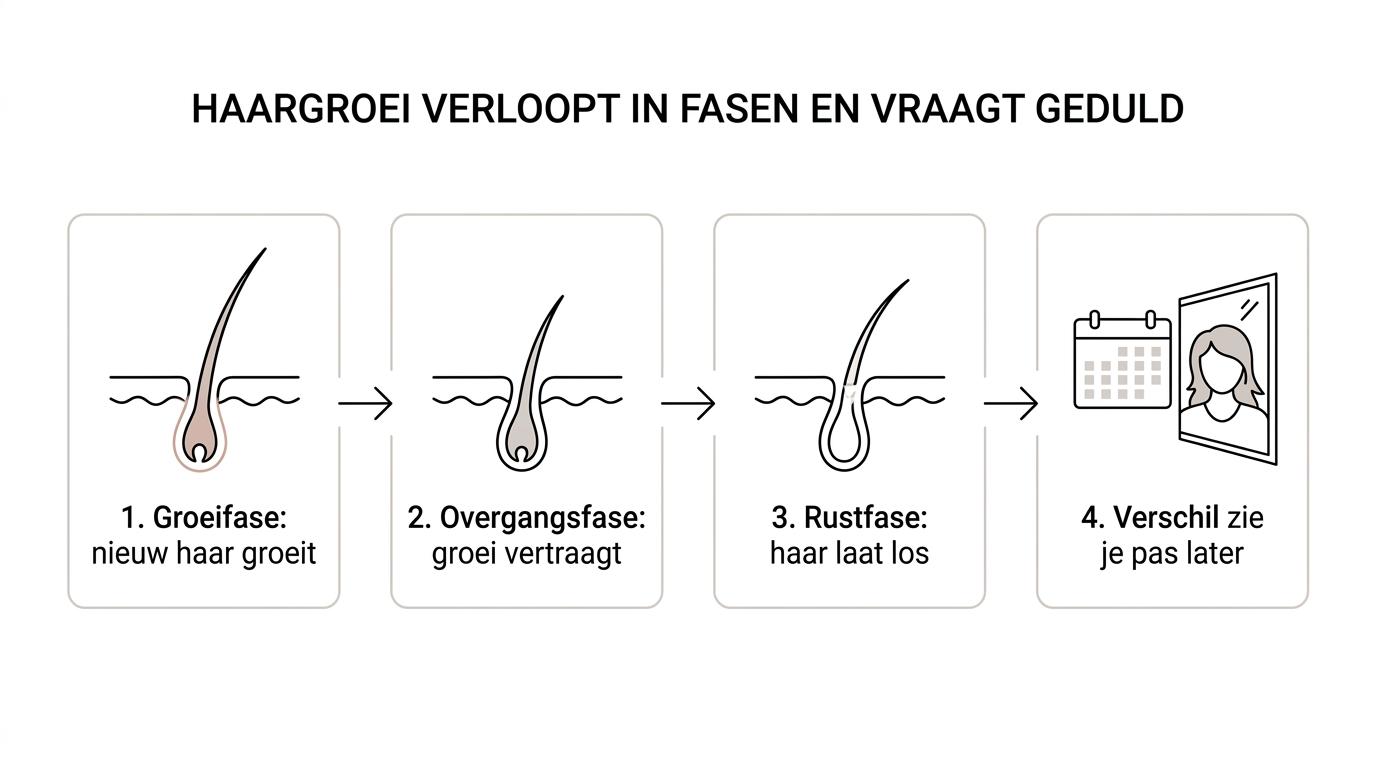
That explains why hair growth takes time. What you change in your routine today usually only becomes visible in the mirror weeks or months later. Many people stop an approach too quickly because they don't see a difference after two weeks. With hair, patience is not a detail, but a prerequisite.

Another important point: "more hair growth" doesn't always mean hair grows out of the scalp faster. Often, it's about less hair breakage, less scalp inflammation, and a longer growth phase. This makes the hair appear fuller, denser, and healthier.
Hair growth rarely accelerates due to a single remedy.
Daily habits that support hair growth
A healthy hair root requires energy, building blocks, and rest. Proteins are needed to build keratin, the structural protein of hair. Deficiencies in iron, zinc, vitamin D, and vitamin B12 have long been associated with hair loss. This doesn't mean everyone needs supplements, but it does mean that nutrition forms a solid foundation.
Crash diets are often detrimental. When the body receives too few calories or too little protein for a prolonged period, it switches to survival rather than building. Hair is not a priority then. This is not always immediately visible, but often several months later, when more hair suddenly falls out. Also, excessively high doses of certain supplements are not a good idea. Taking more is not automatically better.
Sleep and stress deserve as much attention as nutrition. Chronic stress can disrupt the hair cycle and push more hairs into the resting phase simultaneously. A restless sleep pattern, insufficient recovery, and constantly high tension make the body less stable. Hair reacts to this. Regularity often helps more than people think.
A strong foundation usually looks simple:
- Sufficient protein
- Sufficient water
- Regular sleep
- Fewer crash diets
- Less smoking
- More exercise
- Less peak stress
Those who want to refine their routine can focus on these pillars:
- Nutrition: regularly choose fish, eggs, legumes, yogurt, nuts, and green vegetables.
- Hydration: dry, brittle hair feels more vulnerable when fluid intake is structurally low.
- Recovery: aim for regular sleep hours and sufficient rest periods during busy times.
- Stress management: walking, breathing exercises, yoga, or strength training can help to temper tension.
- Medical check-up: with noticeable hair loss, a blood test for iron, vitamin D, or thyroid values can be useful.
Scalp care and styling for less hair breakage
Many people focus only on new hair growth, while losing a lot of length due to damage along the way. Hair that breaks off cannot become visibly longer. That's why protection is so important.
A healthy scalp is clean, balanced, and not constantly irritated. This does not require an aggressive routine. A mild shampoo, a conditioner that keeps the hair supple, and lukewarm water are often a strong start. Washing too hot, degreasing too often, and rubbing dry vigorously can make the hair more fragile.
Styling also has an impact. Tight ponytails, very tight braids, and daily use of a straightener or curling iron can eventually lead to hair breakage or traction on the hair follicles. This is especially noticeable at the hairline, temples, and crown. Wearing it looser is not only more comfortable, it is often smarter for the long term.
A simple care routine doesn't have to be complicated:
- Wash your hair with a mild shampoo, adapted to your scalp and not just your hair lengths.
- Use conditioner after every wash to reduce breakage.
- Pat dry with a soft towel instead of rubbing vigorously.
- Gently detangle with a wide-tooth comb, especially when hair is wet.
- Limit heat and use a heat protector when blow-drying or styling.
A small adjustment in habits often yields more results than another extra product in the bathroom.
Natural methods for hair growth with realistic expectations
Natural support can be a good addition, as long as expectations remain clear. Not every oil or plant has a solid scientific basis, but some ingredients are gaining more and more attention. Rosemary oil is a good example. Research suggests that it can support the scalp and positively influence hair parameters when used consistently.
Scalp massage is also interesting. Not because it makes hair grow twice as fast, but because it supports blood circulation and keeps the skin more supple. Some studies mainly show gains in hair thickness. This may seem limited, but precisely that extra thickness can make hair visibly fuller.
Castor oil, lavender oil, coconut oil, and argan oil are often used in home routines. They can make hair softer and the scalp feel more pleasant. This is valuable, but you must continue to see the difference between care and proven medical treatment. Natural oils can help, but they do not replace a diagnosis for persistent or sudden hair loss.
If you want to start with this, it's best to keep it simple:
- Rosemary oil: interesting as an additional scalp care with consistent use.
- Scalp massage: 3 to 5 minutes a day is often sufficient.
- Coconut oil or argan oil: useful for limiting hair breakage in the lengths.
- Lavender oil: pleasant in a routine that also aims for relaxation.
- Test carefully: use new oils sparingly at first to rule out irritation.
Less, but more regularly, usually works better here than a lot at once.
Products and treatments for hair growth compared
Anyone looking for solutions quickly realizes how wide the range is. From caffeine shampoos to serums, vitamins, laser helmets, and microneedling: the market is busy, loud, and often promising. However, not every claim is equally well-substantiated.
Topical minoxidil remains one of the best-researched options for certain forms of hair loss, especially hereditary hair loss. It does require daily use and sufficient time. Ketoconazole shampoo can be useful when the scalp is also inflamed, flaky, or sensitive. Supplements are only truly logical when a deficiency has been established. Without a deficiency, the gain is often limited or uncertain.
Professional methods such as low-level laser therapy and microneedling are gaining more attention because they regularly show positive effects in studies, especially as part of a broader approach. They do require commitment, correct application, and realistic expectations.
|
Method or product |
Potential added value |
Important consideration |
Evidence strength |
|---|---|---|---|
|
Minoxidil |
Can support hair density and growth phase |
Use daily, results only after a few months |
Strong |
|
Ketoconazole shampoo |
Can help reduce scalp irritation and inflammation |
Especially useful for flakes or sensitive scalp |
Moderate |
|
Biotin or other supplements |
Useful for a real deficiency |
Without deficiency, often little extra effect |
Low to moderate |
|
Vitamin D or iron |
May be necessary for deficiencies that trigger hair loss |
Best targeted after blood test |
Moderate to strong for deficiency |
|
Laser therapy (LLLT) |
Can support hair density with consistent use |
Device quality and treatment adherence are important |
Moderate |
|
Microneedling |
Can be interesting as a supplement |
Correct technique is needed to avoid irritation |
Moderate |
|
Caffeine or growth shampoos |
Often attractive in marketing |
Claims precede the evidence |
Low |
What shampoos and serums can realistically do
A shampoo remains in contact with the scalp for only a short time. Therefore, the effect is usually more limited than advertisements suggest. This does not mean that shampoo is unimportant. A good formula helps keep the scalp calm and clean, which provides a better basis for hair growth. However, you should not make a complete treatment plan out of a shampoo.
Serums can be more interesting because they remain on the scalp longer. Still, the question remains which active ingredients they contain, in what concentration, and whether there is solid research behind them. The best product is not necessarily the most expensive product, but the product that suits your scalp, your goal, and your usage discipline.
When supplements do make sense
Supplements often get an almost magical reputation. In practice, they are mainly useful when the body truly lacks something. Someone with low iron or a vitamin D deficiency can indeed notice improvement after targeted correction. Without a deficiency, the chance of a spectacular difference is small.
A thoughtful approach therefore works better than simply stacking capsules. Especially with chronic hair loss or fatigue, it is wiser to first check if there is an underlying explanation.
When hair loss requires medical advice
Not every form of hair loss is normal or temporary. Sometimes there is more going on than seasonal shedding or some breakage due to styling. Quick recognition then makes a big difference.
Pay extra attention when hair loss is accompanied by itching, pain, redness, or flakes. Also, bald spots, sudden severe diffuse shedding, a receding hairline in a short time, or hair loss after illness or medication require more attention. Hormonal changes, thyroid problems, deficiencies, and inflammatory diseases can play a role.
Signals you should not dismiss:
- Suddenly a lot more hair in the shower
- Bald or round spots
- Painful or burning scalp
- Flakes and redness
- Hair loss after fever, surgery, or childbirth
- Clear increase over several weeks
A doctor or dermatologist can then help to better distinguish the type of hair loss. This prevents frustration, wasted time, and unnecessary expenses.
A 90-day approach for visible progress in hair growth
Three months is a realistic period to give a new hair strategy a fair chance. Not to judge your final result, but to see if your scalp becomes calmer, hair breakage decreases, and shedding reduces. These are often the first signs that you are on the right track.
Start with the basics: regular nutrition, sufficient protein, good sleep, and a gentler washing and styling routine. Then add one or two targeted steps, not six at once. Think of daily scalp massage, a mild serum, or a product line that focuses on scalp care and hair strengthening. This way you can better assess what does and doesn't work.
Those who want to build a care routine with a focus on hair growth and scalp health can take a look at the hair growth collection from Arometica. This is a logical next step for those who want to combine mild care with a targeted approach.
Also take photos in daylight, always from the same angle.
That sounds simple, and that's precisely why it works. Consistency gives hair the best chance to return to a strong growth phase, with less breakage, more resilience, and a scalp that feels balanced again.
