


When you think of anti-aging, wrinkles are often the first thing that comes to mind. However, skin aging starts much deeper. The skin gradually loses collagen, elastin, and moisture, while external factors such as UV radiation, stress, and air pollution accelerate this process. Anti-aging is therefore not just about "fewer lines," but about skin that remains strong, calm, supple, and resilient.
The good news is that you can have a lot of influence on this today. With targeted care, smart lifestyle choices, and active ingredients backed by solid research, your skin can look noticeably fresher and healthier for longer.
How skin aging works: intrinsic and extrinsic aging
Skin aging occurs through two pathways. On the one hand, there is intrinsic aging: the natural biological process associated with age, hormones, and genetic predisposition. This slows down cell renewal, decreases sebum production, and reduces the amount of collagen. The skin becomes thinner, drier, and less elastic.
On the other hand, there is extrinsic aging. This is the form that is strongly influenced by your daily habits. Sunlight is by far the biggest factor here. Chronic exposure to UV radiation breaks down collagen, promotes hyperpigmentation, and coarsens the skin's texture. Smoking, lack of sleep, an unbalanced diet, and chronic stress also accelerate this process.
This distinction is important, because that's precisely where your biggest gains lie.
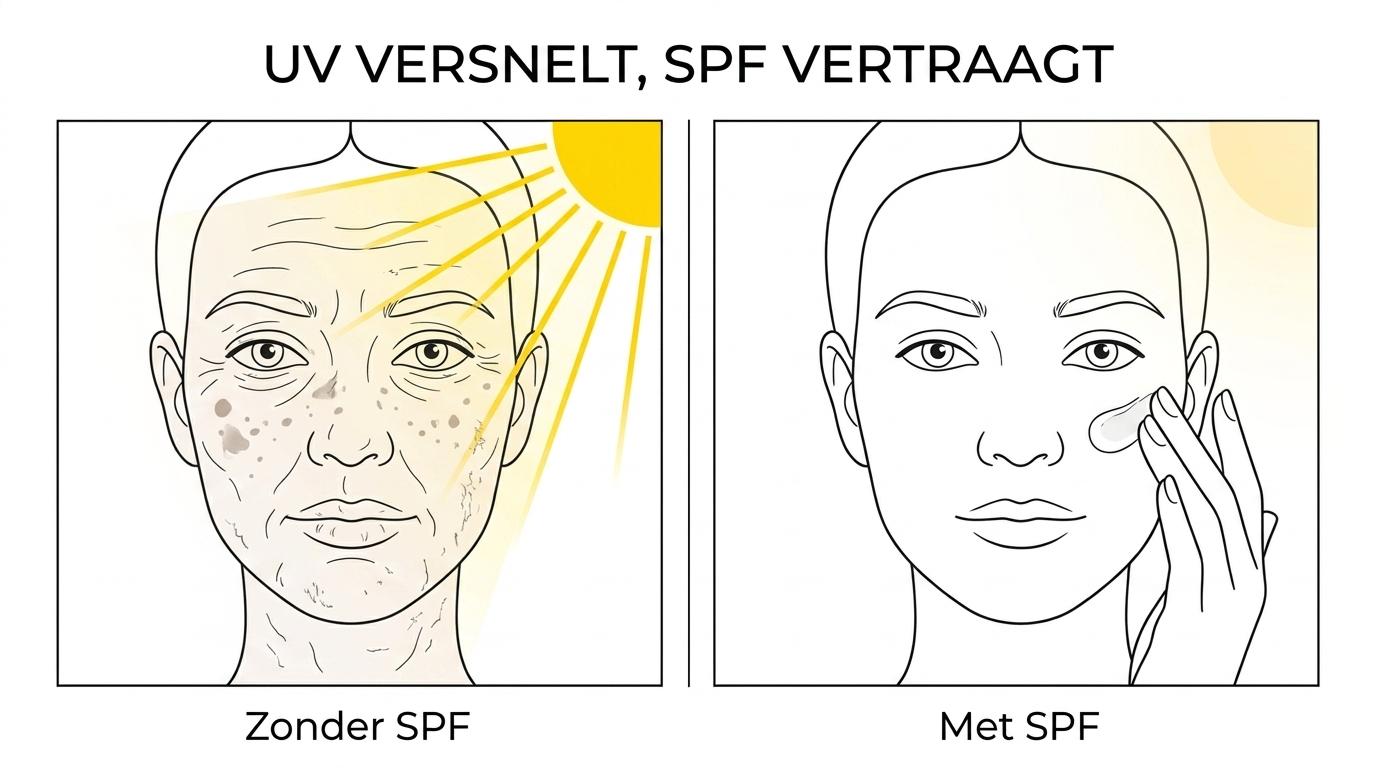
A realistic anti-aging approach does not try to "switch off" the natural pace of aging. It focuses on slowing down, protecting, and restoring. Those who do this consistently often see more results than those who constantly search for a miracle product.
Anti-aging lifestyle with visible effects on the skin
Strong skin doesn't start in the bathroom, but in your daily routine. Research indicates that lack of sleep, dehydration, and prolonged stress not only affect your energy but also the quality of your skin. You'll see this in a duller complexion, slower healing, increased sensitivity, and more rapidly visible lines.
So, those who take anti-aging seriously gain a lot from simple, sustainable habits.
- Sleep: aim for 7 to 8 hours per night, ideally at consistent times
- Hydration: drink enough water throughout the day, often around 1.5 to 2 liters in addition to fluid from food
- Exercise: combine walking, cardio, and strength training for circulation and overall recovery
- Stress regulation: breathing exercises, meditation, or moments of rest indirectly help the skin
- Sun protection: daily SPF 30 or higher, even on cloudy days
Sleep is particularly powerful. During the night, the skin works on repair, inflammation control, and barrier construction. Too little sleep often quickly translates into a tired appearance. Regularity makes a bigger difference here than many people realize.
Exercise deserves just as much attention. Regular training supports blood circulation, helps with stress management, and is linked in studies to beneficial effects on cellular aging mechanisms. You don't have to be a top athlete for this. Consistency beats intensity.
Anti-aging nutrition: building collagen and protection from within
Nutrition cannot completely stop skin aging, but it can certainly help manage it. The skin needs amino acids, fatty acids, antioxidants, vitamins, and minerals to produce collagen, repair damage, and retain moisture. A diet with many highly processed foods, high sugar intake, and few micronutrients works against this.
Antioxidants, in particular, receive a lot of attention, and rightly so. They help neutralize free radicals, which are formed by factors such as UV radiation, stress, and pollution. Free radicals accelerate damage to cells, proteins, and fats in the skin. Think of vitamin C, vitamin E, carotenoids, and polyphenols from vegetables, fruits, tea, and cocoa.
Healthy fats are also important. Omega-3 fatty acids support the skin barrier and help prevent dehydration. This often translates into smoother skin that feels less tight. Fatty fish, walnuts, flaxseed, and chia seeds are therefore interesting choices.
The table below summarizes the main nutrients.
|
Nutrient or substance |
Possible effect on the skin |
Practical sources |
|---|---|---|
|
Vitamin C |
supports collagen formation, helps limit pigmentation |
kiwi, citrus, bell pepper, berries |
|
Omega 3 |
helps the skin barrier and suppleness |
salmon, mackerel, flaxseed, walnuts |
|
Vitamin E |
antioxidant protection |
nuts, seeds, vegetable oils |
|
Carotenoids |
support for skin protection against oxidative stress |
carrot, sweet potato, spinach |
|
Zinc and selenium |
support for repair processes |
shellfish, eggs, nuts |
|
Collagen peptides |
linked in studies to improved elasticity and reduced wrinkle depth |
supplements, specific foods |
|
Polyphenols |
antioxidant effect |
green tea, cocoa, berries |
Supplements can play a role, although they remain an addition and not a replacement for a strong diet. Collagen peptides are regularly researched and show promising signals in meta-analyses for elasticity, hydration, and wrinkles. Omega-3 and polyphenols are also interesting. Substances like NMN, resveratrol, and spermidine are receiving a lot of attention, but still require nuance. Not every much-discussed molecule has equally strong human evidence yet.
Therefore, opt for a calm, scientifically informed approach rather than quick promises.
Anti-aging skincare: which ingredients have the most evidence?
A good anti-aging routine doesn't have to consist of ten steps. The core is simple: protect in the morning, repair in the evening, and always respect the skin barrier. Within that logic, there are several active ingredients that clearly stand out.
Retinoids, including retinol, are among the most researched ingredients against skin aging. They support cell renewal and stimulate collagen production. This can improve fine lines, rough skin texture, and a dull complexion. However, many people should introduce retinol gradually, as irritation is possible.
Vitamin C is another strong player. This antioxidant helps protect against oxidative stress, supports collagen synthesis, and can help fade hyperpigmentation. Vitamin C is particularly interesting in a morning routine, in combination with sun protection.
Niacinamide is very versatile. It helps the skin barrier, can soothe redness, even out skin tone, and regulate sebum production. This makes it useful for both drier and combination skin.
Hyaluronic acid gives a fuller, comfortable skin feel by attracting and retaining moisture. Peptides are often used to support the skin through signal communication. Ceramides, in turn, replenish deficiencies in the skin barrier, which is especially useful for dryness, sensitivity, or when using more active ingredients.
After a well-considered product choice, the order becomes important.
- Cleanser
- Serum with active ingredients
- Moisturizer
- Sunscreen in the morning
Exfoliants like AHA or BHA can provide extra glow and refinement, but use them in moderation. Exfoliating too often can make the skin more sensitive, which is precisely what you want to avoid in anti-aging. Calm skin generally looks younger than overstimulated skin.
Building an anti-aging routine: morning and evening without excess
The best routine isn't the longest, but the one you stick to every day. Many people achieve great progress with three to four consistent steps. Especially with anti-aging, long-term consistency makes all the difference.

A practical morning routine starts with a gentle cleanser or just lukewarm water, depending on your skin type. This is followed by an antioxidant or hydrating serum, then a day cream, and always sun protection. SPF remains the cornerstone of any anti-aging strategy. Without UV protection, you often counteract a part of your evening routine during the day.
In the evening, you can work more targeted. First, cleanse, possibly double cleanse if you wear makeup or sunscreen. Then a serum with retinol, peptides, or niacinamide can follow, concluded with a repairing cream. A richer formula is often useful as your skin becomes drier with age.
This rhythm works well for many skin types:
- Morning: cleanse, vitamin C or niacinamide, hydrating cream, SPF 30 or 50
- Evening: cleanse, retinol or peptide serum, nourishing cream
- 1 to 2 times a week: gentle exfoliation or an extra hydrating mask
- Sensitive skin: barrier repair first, then gradually introduce active ingredients
Do not apply active ingredients all at once in high concentrations. A routine with vitamin C, retinol, exfoliant, pigment serum, and multiple boosters may look good on paper, but in practice, it often leads to redness and dryness. The skin performs better with a clear structure.
By the way, the neck, jawline, and décolleté deserve the same attention as the face. Aging often becomes visible there more quickly.
Professional anti-aging treatments: when are they useful?
Home care forms the basis, but some people want extra support. Professional treatments can then be a great addition, provided the indication is correct and expectations remain realistic.
Injectables can address expression wrinkles or volume loss. Lasers and IPL are often chosen for pigmentation, vascular damage, and texture improvement. Microneedling and radiofrequency focus more on collagen stimulation. Chemical peels help with dullness, superficial hyperpigmentation, and texture.
The quality of your daily routine remains important even then. A treatment without good aftercare, without SPF, and without skin barrier support rarely gives a lasting beautiful result. Therefore, seek good advice from a doctor or skin therapist, especially if you have active conditions, pigment sensitivity, or very reactive skin.
Choosing anti-aging products: smart combining instead of stacking
When buying products, it's best to first consider your skin goals and tolerance. Do you want more radiance, less pigmentation, more hydration, or a firmer appearance? That determines which active ingredient takes precedence. Not every serum needs to be in your cabinet at the same time.
A simple decision aid is often more helpful than long product lists.
- For dull skin: vitamin C, gentle exfoliation, daily SPF
- For fine lines: retinol, peptides, hydrating cream
- For hyperpigmentation: niacinamide, tranexamic acid, vitamin C, strict sun protection
- For dryness and tightness: hyaluronic acid, ceramides, richer cream
- For sensitive skin: mild cleansing, barrier repair, slow introduction of actives
A product is only "good" if you enjoy using it, stick with it, and your skin tolerates it. That sounds simple, but that's often where things go wrong. The best routine feels achievable, not exhausting.
Arometica anti-aging collection: products with a clear place in your routine
If you want to start or refine your routine in a targeted way, you can look at Arometica's anti-aging collection. This selection includes various formulas that fit into a modern anti-aging routine, focusing on hydration, even skin tone, repair, and support of skin structure.
Below are some products that align well with the most common skin goals.
|
Product |
Active ingredients |
Suitable for |
Usage |
|---|---|---|---|
|
COCOON SKIN EGF Serum |
EGF, supportive extracts |
skin that wants to support elasticity and repair |
after cleansing, before cream |
|
ANUA Niacinamide 10% + TXA 4% Serum |
niacinamide, tranexamic acid, arbutin, hyaluronic acid |
hyperpigmentation, post-acne marks, more even skin tone |
morning and/or evening, always SPF during the day |
|
COSRX Vitamin C 13% Serum |
stable vitamin C, hyaluronic acid, allantoin, vitamin E |
dull skin, first signs of aging, uneven skin tone |
especially in the morning under sunscreen |
|
COSRX Advanced Snail 92 All-In-One Cream |
snail secretion filtrate, allantoin, adenosine, panthenol |
dry, sensitive or repairing skin |
as a final cream, often ideal in the evening |
These combinations are logical for many skin types:
- Radiance and protection during the day: vitamin C serum followed by a cream and SPF
- More even skin tone: niacinamide plus tranexamic acid for pigment sensitivity
- Repair and comfort: a richer cream as the final step in the evening
- Extra support: EGF serum as an addition when the skin feels less firm
If you're still searching, it's best to stick to one main goal for a period of six to eight weeks. This way, you can better assess what works. Only then add a second active ingredient. Especially with pigment serums and retinol, patience is not a detail but a prerequisite.
Patch testing remains sensible, especially for sensitive skin. And if you use strong retinoids, are pregnant, or have an active skin condition, professional advice is recommended.
A good anti-aging routine doesn't have to be complicated. It mainly requires knowledge, rhythm, and the right products at the right time. Those who start today are not only working on more beautiful skin for tomorrow, but also on more comfort and confidence in daily life. If you want to choose specifically based on your skin goals, Arometica's anti-aging collection is a logical place to start.
